

Why?
Constant change and unpredictability have become the norm. For teams to thrive in the face of uncertainty and adversity, we crafted an innovative approach, with a proprietary tool to diagnose and develop antifragility in teams.
Antifragility is the ability of a system to thrive and improve by using external stress factors, shocks and uncertainty.
The concept of antifragility has been detailed by Nassim Nicholas Taleb in his book “Antifragile: Things That Gain From Disorder”. Building on his research and findings on antifragility in various systems, we developed an antifragility approach for team performance.
In prolonged contact with stress factors, fragile teams break, robust teams resist and stay the same, and antifragile teams develop by using them to become stronger.
Antifragile teams are those that not only cope with volatility and randomness, but actually become stronger under pressure.
Drawing on our extensive experience working with teams and applying the foundational principles of antifragility, we have developed a proprietary diagnostic tool specifically designed for teams.
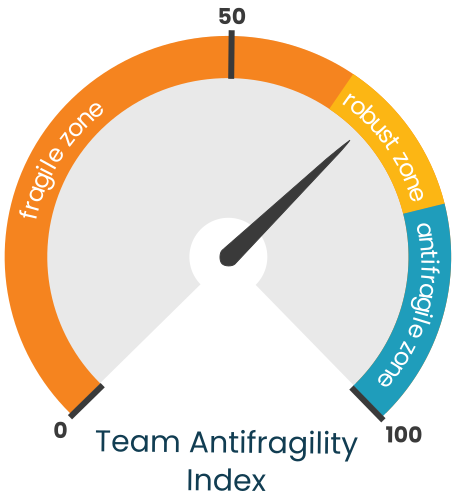
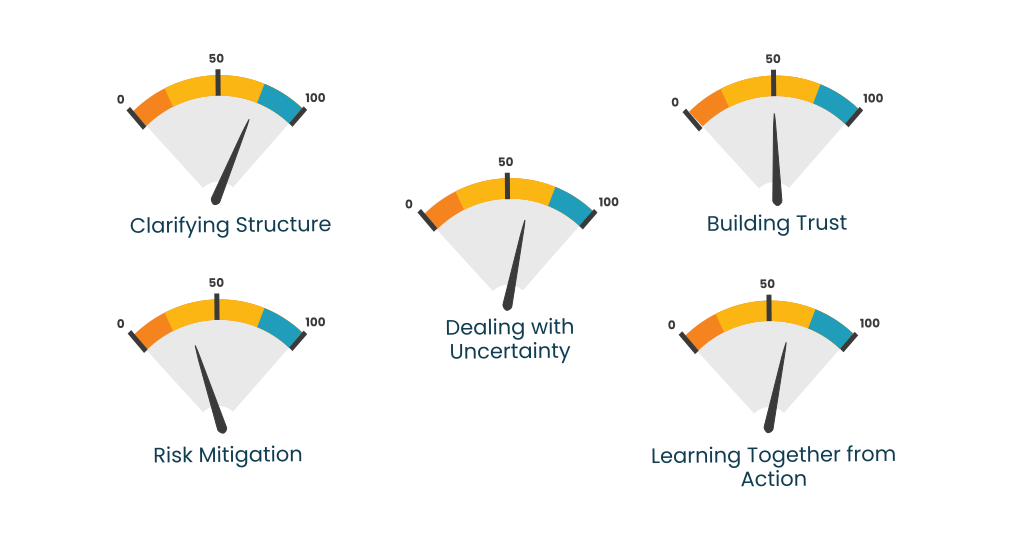
Completing the Team Antifragility Diagnostic gives you a clear picture of where your team stands. The assessment measures the Team Antifragility Index — placing the team in the fragile, robust, or antifragile zone — then examines each of the 5 core pillars in depth, uncovering the drivers behind them to pinpoint where your team has the most to gain.
Your team retains full ownership of what to prioritize. We equip them with solid data: the relative importance of each driver and your team’s current scores, so decisions are grounded in evidence.
One particularly powerful lens is the gap between how the leader perceives the team and how team members see it. Understanding this difference helps leadership choose interventions that actually move the needle.

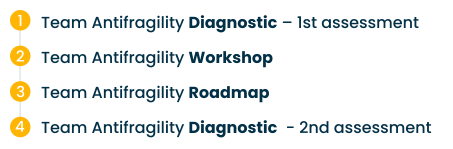
Based on your Team Antifragility Diagnostic results, we design a tailored workshop to develop your team’s antifragility. The session introduces the core concepts of team antifragility and works through your team’s specific results together. We provide practical guidance and tools to help your team understand where it stands today — and grow stronger in the face of market changes and uncertainty.
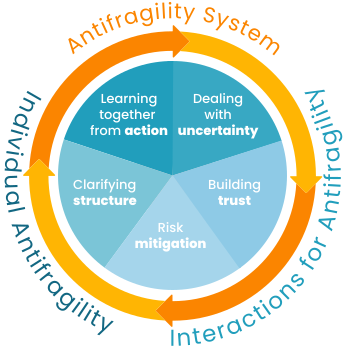
Building antifragility in teams requires a three-level approach:
Level 1:
Building antifragility at the individual level
Level 2:
Designing specific interactions that promote antifragility among team members
Level 3:
Creating a system that supports continuous antifragility
To become antifragile, teams need to develop 5 building blocks, each involving specific actions at the individual level, interaction level and system level.
These building blocks are:
1
Clarifying Structure
This pillar is a prerequisite — necessary, but not sufficient for antifragility. It gives the team direction: clarity on purpose, roles, responsibilities, and how members communicate. Without it, investments in learning, trust, conflict management, or risk mitigation don’t take hold — teams that score low here are almost always stuck in the fragile zone. However, once clarity is in place, it stops being a differentiator: nearly all robust and antifragile teams score similarly high. It won’t make your team antifragile, but nothing works without it.
2
Building Trust
Trust is the foundation of everything the team can become. Most teams have a baseline level of trust — respect, reliability, good intentions. But antifragility requires more: a kind of trust where people feel safe to admit mistakes, voice concerns, and tell each other the truth — even when it’s uncomfortable. Without this deeper trust, learning stays shallow, feedback gets filtered, and conflict becomes destructive rather than productive.
3
Learning Together from Action
For a team to become antifragile, it must learn and grow together — not just as individuals, but as a collective, based on real shared experiences. This doesn’t happen by default, but rather by design: structured feedback loops, intentional experimentation, clear processes for learning from projects, and a constructive approach to mistakes. This is the engine of the system — the pillar with the biggest impact on whether a team stays fragile or grows stronger.
4
Dealing with Uncertainty
Antifragile teams don’t just survive uncertainty — they get stronger because of it. This pillar is the muscle of the system: it grows through effort. At its core is the ability to handle disagreements constructively, turning different perspectives into better decisions. It also requires transparency within the team, autonomy to solve problems independently, and — for the most ambitious teams — deliberate exposure to unfamiliar situations to build comfort with the unexpected. As an enabler, this is the pillar that raises the quality of all others — from sharpening the team’s clarity of purpose to deepening trust, accelerating learning, and strengthening the safety net.
5
Risk mitigation
Antifragile teams take risks — but smart ones. They know what they can afford to lose and what they can’t. This requires clear processes for evaluating risks and opportunities, making sure resources match ambitions, and having backup plans ready for when things go wrong. This pillar is the safety net of the system — you don’t feel it when everything goes well, but it’s what catches you when it doesn’t.
Building upon the discussions held during the workshop, the team crafts a roadmap for future development. The team initiates the implementation of this plan, and after 4-6 months, another assessment of its antifragility can be conducted.
During this period, we can have regular check-ins with the team to measure progress, identify obstacles, and make any necessary adjustments to ensure continued growth.
After 4–6 months of the implementation of its roadmap, teams undergo a reassessment of their antifragility. New reports are generated to help each team reflect on the shifts that occurred and their effects.
The team reviews what changed and what didn’t, then decides how they want to move forward — what to keep, what to adjust.
If you want to assess your team’s antifragility and learn how to become more antifragile, please reach out to us.
Certification in Building Antifragile Teams
Save you place for the 2 intensive days to elevate your impact on team antifragility.
Formular de înregistrare eveniment
Echipe și Organizații Antifragile
Participarea este gratuită, dar locurile sunt limitate.
⇒ Demonstrație live a instrumentului
⇒ Studiu de caz real
⇒ Networking cu lideri din organizații relevante
Formular de înregistrare
Investiție financiară
Pentru 2 sau mai multe persoane din aceeasi organizație, oferim un discount de 10%.
Dacă dețineți un cod de discount, vă rugăm să îl folosiți în formularul de înscriere.
Discount-urile nu se cumulează.
Workshop-ul este unul interactiv, ceea ce limitează numarul de participanți.
Pentru a vă rezerva locul, vă rugăm să completați formularul de înscriere.
Open program
Interested?
If you are interested in the program and want to learn more about what we do and how we do it, please fill in the form.
Open program
Interested?
If you are interested in the program and want to learn more about what we do and how we do it, please fill in the form.
Open program
Interested?
If you are interested in the program and want to learn more about what we do and how we do it, please fill in the form.
Module 2: Leadership
Module 1: Structure
Module 1: Structure
Open program
Interested?
If you are interested in the program and want to learn more about what we do and how we do it, please fill in the form.

